Bread is Life
By Agnes Brandt, An ERI Partner in Berlin
“Du bist, was du ißt.” – “You are what you eat.”
 This meaningful insight into the sociocultural importance of eating is not just recognized by health food and diet gurus worldwide. Looking at the place of food in a society conveys a deeper meaning about the way a society functions. The importance people attach to eating and food tells us something about their values, beliefs and life-choices.
Being a good ethnographer is about getting access to people’s emic perspectives, to the meanings the people themselves attach to certain behaviours and beliefs. In order to do so, we immerse ourselves in the everyday life-worlds of those we are studying. A part of this is to get to know the specific customs around the preparation, sharing and eating of food.
I especially love this aspect of research. I just love food and I always try to go with local delicacies. Okay, okay, I do admit to being limited to non-meat and non-fish products, but I really do try everything vegetarian that I can get my hands on…
Anyway…I easily adapt to local eating-culture by indulging in whatever foods are popular and available, and I usually do not miss my ‘own’ food (partly because I am German and German food is – let’s face it – not the most exciting food you can find on this planet).
However, there is just one food that I am excited about and that I do miss whenever I stay some where for more than just a couple of months – and this I share with most of my fellow countrymen and women. The food that I am talking about is bread.
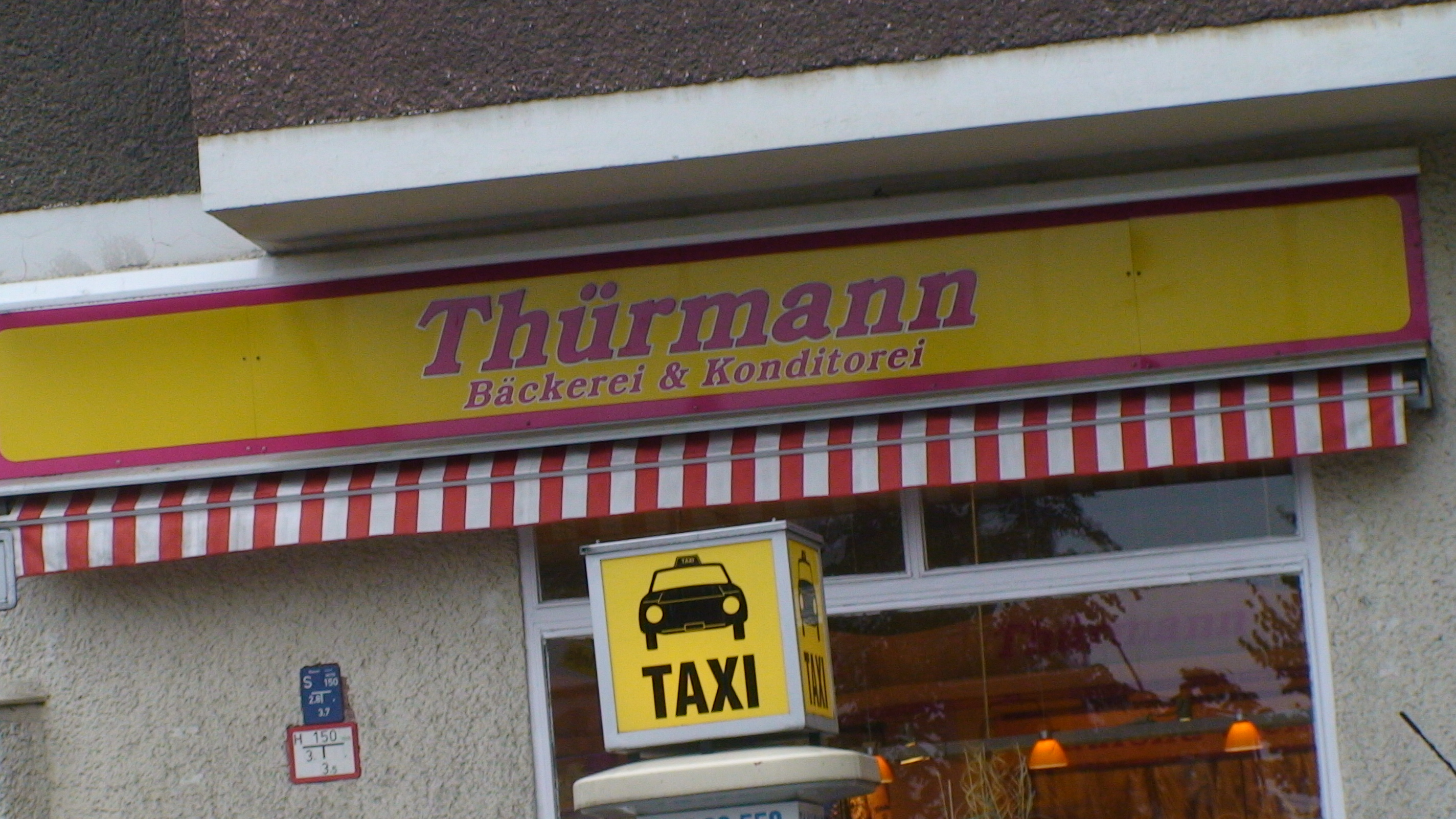
Bread. What about it? The pinnacle of German food culture? Maybe. Maybe not. But one thing is for sure: German bread is the most sorely missed food by Germans worldwide, and we are very proud of our baking culture. In fact, we go to great lengths to find it whenever we leave our home country. German bakeries scattered all over the world are proof of this desire for ‘proper bread’, which is usually dark and heavy, nourishing and substantial. Hmmmmmm.
Yummy! I once read somewhere that we have the greatest variety of Brot worldwide! My favourite bread at the moment is spelt bread, but I also like the classical rye and the particularly solid black bread (Schwarzbrot). If I cannot find any ‘proper’ bread at all, I resort to Pumpernickel, a German black bread specialty available in shops even in far-to-reach places such as Samoa!
Here is something that I found difficult to wrap my mind around: I found out that some cultures consider bread ‘bad’ or even ‘unhealthy’. Now, here is a challenge for the bread-loving German anthropologist!
PS: We have the notion of “liquid bread”–Flüssigbrot. It refers to: beer (what a surprise).
Animals in Ludhiana
by John Kille
After a mix up with flights and luggage, I got to ride through rural northern India, in the state of Punjab, at dusk and into the night. It was dark and the streets were lit only by moonlight and oncoming cars. The traffic at night, from what I could see, was an ensemble of movement. I saw the donkey carts, bicyclists, bicycle rickshaws, scooters, motorcycles, cars, and large trucks. This was my introduction to Ludhiana, where I would be the next week.
There are more animals in the streets here than Mumbai. And I have had several encounters since arriving. During context mapping today, I saw an elephant walking down the street, led by a man with a rope. He didn’t appear bothered by the traffic wooshing by. I told my 6-year-old daughter about this later on skype and she seemed amazed.
Donkey carts are very prominent here, and while on our way to dinner in an autorickshaw, packed with 4 other people, we weaved through traffic and stopped next to a donkey cart—my head about 2 feet from his. The donkey looked over at me and seemed to say, “Hey, how’s it going?”
On the way back from dinner, the auto rickshaw driver dropped me and Sahil, my local ethnographer, off about a half a mile away from the hotel because other people in his vehicle wanted to go left, and he wanted to save gas. We paid him 10 rupees and began walking. The streets were very dark, since electric power is scarcer here, and street lamps are sometimes non-existent or not working.
Near the hotel, there was a large dark blob shifting about in the darkness directly off the road. The curious ethnographer I am, I wanted a closer look. Sahil grabbed my arm and pulled me away. “Be careful, he could run at any time.” I looked again and saw a large bull eating grass, his focus seemed on the food, but that could change.
Berlin
I just arrived in Berlin to spend a week following up on the first half of fieldwork Melinda accomplished. Here’s a few tidbits from my arrival:
– Customs was easy breezy! Just a couple of kiosks outside the arrival gate. In, out and oh so fast.
– I can eat deli meat every morning for breakfast if I want to.
– Coffee. Strong, delicious coffee.
– Berlin does not feel overwhelming or chaotic. I am grateful for that.
– I kind of like Berliner fashion. It looks comfortable, a little bit urban chic and has nice walkable shoes.

More later…fieldwork for me starts tomorrow.
Kazuyo on the Auto-Rickshaw
We’ll be bringing you some of Kazuyo and John’s experiences in India over the next several weeks…
Negotiating with an Auto-Rickshaw Driver
One morning, I went to a fancy hotel in Bangalore to do context mapping. The hotel people were horrified that I was planning to hail an auto-rickshaw to go there. No problem! I hailed one and got there for 15 rupees. So I tipped him and gave him 20 rupees. On the way back, I hail one, and give him my hotel address. He nodded and I got in. He doesn’t push the button to start a meter, I say it to him, “Please start a meter” and he tells me that it would cost me 30 rupees. I look at him, and say “It cost me 14 rupees to get here.” He shook his head and said, “No, 30 rupees.” I kept saying “No,” and asked him to start his meter. He refused. I told him that I would get out and find another one. He thought I was bluffing because I was a foreigner, but he found out that I was not bluffing shortly thereafter!

Auto-rickshaw can go anywhere…except for a herd of cows
It’s not uncommon to see a cow in Bangalore, and I met/saw them frequently. They hang out on the street, on the road, in very random places. Auto-rickshaws are smaller than cars, so they can go through a small alley and can go through dirt roads, mud, etc. But even auto-rickshaw wouldn’t go through a herd of cows, and we had to trail behind them on the dirt road for quite a while!
John: In India.
The rhythm of Mumbai
Landing in Mumbai three days ago, I walked off the plane after a 15-hour
flight into a sweaty oven of an airport terminal. Now to the baggage claim.
After waiting in the wrong carousel for 20 minutes in a sleepy daze, I asked
a local for suggestions. All red bags became potential targets. This one?
No. That one? No. Joy shot through my body as I saw my bag circled around
the corner. Checking the tag. Yes!
Though customs in a mass of people, down a long corridor, the volume of
voices increasing with each step.
Now to find a taxi.
I exchanged money for rupees, and scampered to the prepaid taxi line,
waiting, explaining. Here’s the money. Thank you. Taxi this way? Okay.
Opening the door, the oven temperature turned up, and the volume increased
by two notches–shouting, honking, bright colors, exhaust fumes, days of
sweat, an array of blue, yellow and white cars, and . . .there it is!
Into the taxi and now through the city. Honking, braking, acceleration.
Honking, braking, acceleration. Mumbai traffic. A continuous mass of metal
twisting through the city in this wondrous rhythm of communication, all
minds working together.
Traffic rules seem to cease, or become mere guides. Cars moving forward like
creeping, colorful snake, my driver part of the heartbeat, looking all
directions at once. Four cars wide in a three-lane road, side mirrors folded
in for increased road space, speckles of paint and dent on cars corners.
Red. Blue. Yellow. Can a motorcycle slip by? Yes, there he goes. Handle bar
missing side mirror by a centimeter.
At one point yesterday, an auto rickshaw behind us hit our car slightly,
enough to trade paint, but probably no dents. The driver got out, inspected
the damage, yelled at the culprit, and we moved forward at the flash of
green light. At one thirty am two nights ago, I watched us run one red light
after another, in a blaze of speed–throttle opened up in pure joy, then
braking, honking.
Mumbai traffic. An exquisite example of collective thinking, communication,
and the beauty of human interaction. Four cars wide in a three-lane road.
Braking, honking, braking, honking.
Horns are their voices. Steaming tires are their shoes.
Spain winning the World Cup: “Once in a life time…”
By Laura Tejero Tabernero, an ERI Partner in Madrid
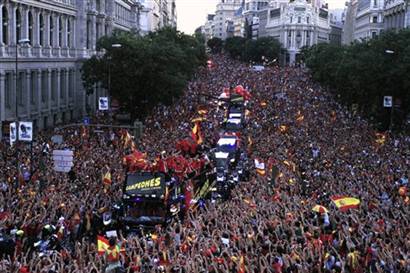
I’ve never really been a football fan but I cannot be more amazed with all that’s happening with Spain winning the World Cup for the first time in its history. I have never seen so many people so collectively happy! Everybody saying, teenagers and elders alike, “This is just once in a life time…, the happiest day for Spain in decades…”
And I wonder for myself, how is this possible? What’s the real social power of football in contemporary societies? It seems to be much more than just pure leisure; much more than a simple competition; much more than just pure business.
Yesterday there was a huge party all around Madrid, a welcoming party for the team players organised by the government. It was one of the biggest concentrations of people in the entire contemporary history of the country, hundreds of thousands of people partying in the streets, all dressed with red shirts. Spanish flags all over the city, everybody waving the national symbols, feeling (or at least pretending to feel) united.
It is just something nobody could expect. Yesterday it seemed like there weren’t any kind of social distances, any kind of regional nationalisms. It was the first time you could here people from all different political ideologies, immigrants who are structural and politically marginalised, screaming out loud: Viva España!
Viva España, one of the most common expressions associated with our own historical past, with Franco’s dictatorship, with a kind of nationalism that is being constantly disapproved by an enormous amount of people who still feel the necessity to fight against fascism.
But, two days after the finals, we came back to real life again. We came back to our one political and economical situation. Nowadays Spain is one of the European countries where the current crisis has had its more perverse social effects, where unemployment rates are the highest and where the political system has lost most of its social legitimization. But it seemed that, at least for two days, this was something people could forget about. It seemed as if people could, once again, feel proud of their country.
But what about the way in which the government has strategically used this fleeting social amnesia? It is not a coincidence that the government decided to make public the new labour market reform the same day in which the Spanish team made its debut in the World Cup. It is not a coincidence the enormous amount of money invested in this victory.
And I ask myself again, what’s the real social power of football in contemporary societies? How can we feel proud of a country that it is being socially devastated? Maybe we, as anthropologist, should start asking people what football really means to them so as to know more deeply the social implications it has. It seems to be much more than just football, more than just mere business….
Kazuyo: I have arrived to India.
Wow, here is my quick update/cultural experience of arriving to India.
Even at ORD airport, the gate heading to India had a little more chaotic feeling to it. Not an unpleasant one. It’s just didn’t feel ordinary. Let’s say compared to getting on a flight to go to Tokyo, it was distinctively different.
Flight was delayed, but we arrived to DEL about an hour late. Going to immigration line, they have lines for Indians and foreigners. There is NOBODY for foreigners’ lines. I wonder “ummmmm……” And another traveler says, “Oh, just wait. It’s just a beginning.”
Some Caucasian people brave to Indians lines, and they seem to have gotten through. Not a problem. So those who are standing in line for foreigners wait patiently and finally, two immigration officers shows up to foreigners’ lines.
No question asked, they look at my passport, visa and give my passport back. No questioning of why I am there, etc., the general customary questions immigration officers ask.
I don’t find an ATM machine. I am glad that I had some US dollar in cash and exchange at the bank. I am sure that the rate isn’t great, but I have Indian rupees now.
Go through custom, and there are lines with people with signs picking up mostly foreigners. I see a sign saying “Pre-paid taxi,” but be aware those are who pretend to be taxi drivers. So I go to the counter and it says CLOSE. I wonder, ok, what now?
Then I go to Jet Airways help desk to see if I can get a boarding pass for tomorrow. But there is a couple who apparently have their luggage damaged and are going through the claim. After standing in line for 15 minutes, they tell me that I need to go to domestic terminal for that.
Finally, I venture out to the arrival area and I see 3 windows for Pre-Paid taxi again. I quickly get in line, 5 minutes pass, 10 minutes pass. The line is not moving at ALL. After 15 minutes of waiting, I ask a gentleman in front of me, what is going on. He says traffic is so bad, there aren’t enough taxi. So just wait.
Meanwhile, everybody in the line is calling SOMEBODY trying to get a taxi or a ride. I tried to call my hotel, but I was not smart enough to program how to call India on my phone and my call fails repeatedly. So text for help to Melinda.
While I am waiting, checking my emails, and trying to be patient. People are yelling and getting upset at the window, so the guy leaves. I am starting to wonder whether I have to spend a night at an airport tonight.
Finally, 2 people come back to the window after 30 minutes or so waiting, and a line to the window (somewhat a line, but not a straight line) breaks out and people start rushing and running to the window.
There are two Asian women who were behind me and they run in front of me to get to another window. I yell at them, “Hey, you were behind me.” They say, “well, you were too slow, besides you were waiting in that line, not this line.” They smirk me a look and wait for their turn. I think to myself, “is there any order here?” It’s just the beginning, I realize later.
Finally, I get to my turn and the window person tells me that it would be 310 rupees. I tell give him 400 rupees and he tells me that I need give him 10 rupee. I tell him I don’t have it since I just landed. He gives me back 100 rupees and charges me 300 rupee instead of 310.
I follow the sign to get to pre-paid taxi and I start crossing and I get yelled at by a policeman I shouldn’t be going that way. Sign is pointing left, but the line for the taxi is on the right. So I get in a line. I see the two asian women who cut in front me without any problem, 3 parties ahead of me. I am thinking, “Japanese niceness has to go, I guess.”
It’s hot, loud, people yelling and shouting. I am thinking that it definitely has different energy compared to the Philippines. The only word that comes to me is chaos, but it’s not the right terminology. I wait and wait and finally a taxi comes up and I get in. It’s HOT and HUMID. I can hardly breath.
Taxi person is very nice and asks me if it’s the first time India for me, I say yes. The traffic is jammed, and the road is packed. I see people hanging on the side of the car—I have seen this on photos, but people really DO that! We drive through and spend maybe 20-25 minutes in the car, perhaps for 5 minutes when there is no traffic (another guy in line told me that it would be 5 minutes to the hotel from the airport). At the toll booth, a man with a stick is checking underneath of trucks—I wonder if they are checking for bombs? Or something being smuggled????
We drive by the field with burning tires (smell indicated that), honking traffic, people randomly stopping on the side of the road. I see squatters and also smell curry. Curry smells GOOD for sure, “Perhaps I will try something right before I leave India,” I think to myself. I am thinking that it kind of reminds me of a combination of Manila and Kaoshang night market.
And suddenly, we pull into a gated area with a mall and that is where the hotel is. Separated from the rest of the chaos, but right next to the highway!
This is definitely a beginning of an adventure, I think to myself.
India here we come!
Kazuyo and John are headed to India. In fact, Kazuyo is probably on a plane as we speak, and John will join her in a little over a week. We’ve traveled all over the world and our stop in India is a new place for us, so we’re pretty excited.
They’re headed to Mumbai, Bangalore and Ludhiana and will hang out with a local Indian ethnographer and other folks as they learn all about luxury lifestyle. Yeah…Taj Palace, Juhu Beach, downtown Ludhiana, and so on.
I am jealous too!
Kazuyo learned during her trip to the Philippines several years ago that eating mangoes (a hot fruit) every single day didn’t go very far in helping her avoid heat exhaustion, so this time she’s going to skip hot fruits as the temperature climbs. Kazuyo lives in Boston, so as far as she’s concerned, gray skies and cold weather is much more her style.
She’s also pretty excited to learn more about Asian culture, especially considering she’s from Japan. “Although India is a part of Asia, it is very different from Eastern Asian culture and offers something really unique from that perspective. It will be interesting!”
John’s excited too. While he knows “India has an extremely rich and interesting culture, packed with an assortment of languages and traditions, and a rapidly growing economy,” he will learn firsthand what that looks like, how it sounds, and what’s changing right now.
But he’s certainly not looking forward to the long plane ride. It takes 24 hours to get there!
Stay tuned AFTER the trip. We are sure that there will be some good stories to share!
It’s not a contradiction. It’s an insight!
We left our last conversation talking about narrative and how we get to learn a whole lot about people by dropping our assumptions about their experiences. In other words, we let them guide our process of understanding through their narrative, and it’s through our analysis of their experience we can really put existing knowledge about them in the proper context.
Which brings us to the second assumption taken from Nurture Shock , the book that recently blew my mind as a parent and an ethnographer. I find the authors’ recommendation to drop a second assumption really relevant in our work.
Bronson and Merryman say, “We tend to think that good behavior, positive emotions, and good outcomes are a package deal: together, the good things will protect a child from all the bad behavior and negative emotions…”
The book pretty much offers a slew of evidence that shows how this is not always true. In the end (and this is the part I really love, the part that makes me jump up and down) they said, “The researchers are concluding that the good stuff and the bad stuff are not on opposite ends of a single spectrum. They are what’s termed orthogonal–mutually independent. Because of this, kids can seem to be walking contradictions.”
Again, we could substitute the word “kids” with “moms with toddler girls” or “people with diabetes” or “men losing their hair.” And again, we can really place what seems like contradictions in the proper context through…wait for it…wait for it…our analytic process.
See, we always tell our clients that a lot of people who say they do ethnography actually don’t. Doing an in-home interview is great, videotaping it and editing a summary of all those interviews is great, but that alone isn’t making it ethnography. It’s the systematic analysis of our fieldwork, those in-home visits, as well as how we contextually map our topic of study in the places we do fieldwork, that helps to make it so.
We actually start doing analysis once we start recruiting, all along during our fieldwork, but the really intensive systematic analysis occurs after we have left the field. To do it right, it takes about 4 to 6 hours for every hour we spent in the field, to really understand what we learned.
And here’s why. Remember that assumption we just talked about. People can seem like walking contradictions. We typically find that there are disconnects between what people say and what people do. If we rely simply on what they say, it will look like a contradiction. Or it will be taken at face value through literal interpretation, thereby discounting all the observational stuff (and ultimately, what explains what’s really going on) we may not have noticed during that precise moment.
By going back and systematically analyzing not only what was said but what was done, how it was done and why, and looking at it across all our participants to find pattners in similaries and patterns in differences, we can say “Aha! This is what’s happening.” We simply cannot overlook any subtlety or nuance. Otherwise, it’s just not insight.
So, try dropping a couple of assumptions. Like my seventh grade math teacher said, “It just makes an ass out of u and me.”
Fan us on Facebook!

 Ethnotale: Up Close and Personal